
Did you know that on average, one tree can absorb 21.77kg of CO2 per year? But what does that mean? Well, according to UK Government conversion factors it means:

- Driving about 77 miles in a medium sized petrol car
- Or boiling a kettle 106 times (probably about 500 cups to tea)
- Or flying 83km, or only 27km if you’re going fancy in First Class
It also means you’d need about 23 trees to run Google for one second.
Let that sink in…
Google has over 50,000 visits per second, equating to half a tonne of CO2 per second. It’s truly amazing. Maybe they run on renewable energy, maybe they don’t. Either way, that’s a lot of emissions!
There’s a visual art project by Joana Moll that simulates usage in real time. Check it out here once you’ve finished reading this blog and see how much CO2 has been emitted in that time. (I hope you’re a fast reader!)
So what is a Digital Carbon Footprint?
Your Digital Carbon Footprint is a term used to quantify all the emissions generated from your online activities and lifestyle. Which is unprecedentedly large.
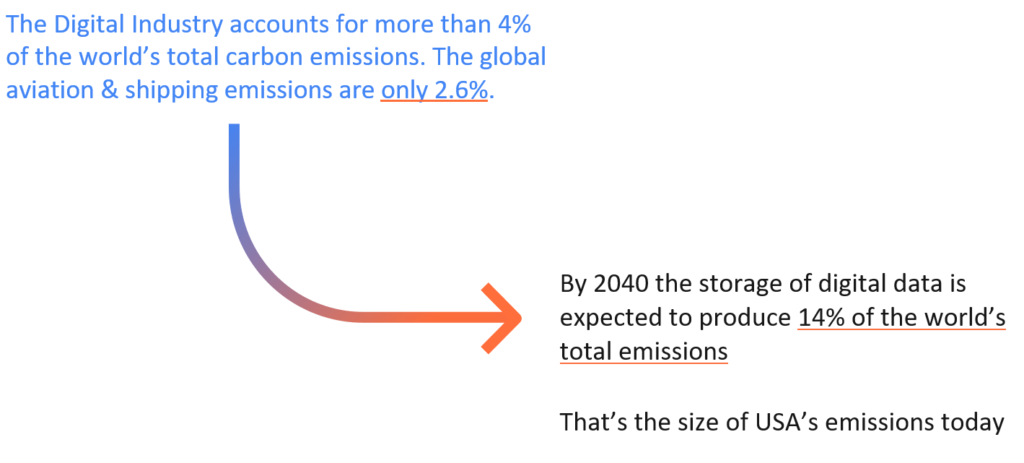
The digital industry today accounts for >4% of the world’s total carbon emissions. By 2040 that’s expected to increase to >14% of the world’s emissions (Ourworldindata.org)!
But what causes these emissions?
The largest causes of emissions come from 3 main places:
- Data centres – The home of all the computer systems used to store data and information that enables the internet to work as it does
- Networking – The way data and information moves around
- Your stuff – This is the actual devices you use, but also the online services and products you use (Spotify, Netflix, Apps, Bank accounts, rail card, etc.)
The combination of them all is the backbone of the internet, and it requires a lot of energy to keep it going.
Data centres are the largest source of this, consuming massive amounts of energy to run and cool. This problem is particularly damaging because we can’t ‘see’ the impact of digital impact is having, it might feel like it’s far away. You could almost say “out of sight, out of mind” because we have become so used to having technology in our lives every day, from our mobile phones and tablets, through to the laptops and PC’s we work from daily. It all makes our lives easier in some way shape or form.
Getting practical – How do we reduce our Digital Carbon emissions?
Every business is a digital business even in its smallest form. It’s inescapable and naïve to think a business doesn’t have digital carbon emissions. With awareness of what our digital impact and emissions might be comes education, which causes action.
Here at Optimo, we focus on improving operations for Change Makers. Businesses that have a mission to make the world a better place. Whether you were ‘born green’ or are ‘turning green’, or have a climate or community purpose. The more effective you work, the larger your impact.
Hand in hand with efficiency and operational effectiveness is lower emissions. So, using sustainability as a lens for analysis and operational efficiency is a no-brainer and a win-win.
Here’s some tips from our Digital Carbon Footprint checklist to help you get started:
- Green Hosting – The average web page emits approximately 0.8g of carbon per page view. Implementing some efficiency measures, starting with swapping to a renewably powered hosting company, can drastically reduce yours some. WebsiteCarbon.com highlights efficiency sites that emit 25% of that average. Scaled up that could be saving 100skgs of carbon with very little effort.
- Dark Data – This is the information you keep and store, but rarely or never use. It’s all taking up space, puffing up CO2 from a Data Centre somewhere. Taking the time to design data policies that actively tackle data, preventing its build up and regularly cleaning it up could considerably lower your emissions. It will also work wonders for your cyber security too, because the less data you handle, the lower the security risk. With modern database controls, it’s simple enough to set up auto-deletes or sweeps that flag old and unused data. If you do need to keep it, do it with a green cloud provider.
- Choose wisely – Everything comes with a carbon cost.
- Colours – Particularly on OLED and AMOLED screens which light up individual pixels to display things, and darker colours save a lot of energy. This is because the screens turn off the pixels used to display that information. This has a big impact on mobiles and tablets. So, on this occasion, it’s probably best to move to the dark side.
- Fonts – Custom fonts must be downloaded by the browser, this isn’t the case with default and system fonts (Calibri, Arial, etc). Varying font style also requires differences in data load. Speak with your UX designers to make sure they’re aware of this and consider the impact when they designing and implementing.
- Sustainability requirements – Foremost, if you’re designing an online product, service, or website, take the time to create sustainability requirements that specify the target and maximum carbon weight of different elements. For example, the page weight per view must be less than 0.3g CO2. This is a tangible measure to design, test against and improve on.
- Image & Video usage – Images are among the most data-heavy elements on the web, and choosing the right format can drastically affect energy use, data transfer, and carbon emissions. Scrolling TikTok emits 2.63g CO2e per minute. Image compression and using modern formats are critical. WebP and SVG are both much more efficient formats than PNG or JPEG file types. If you have a media-heavy site, this could be an easy win for reducing your site’s digital carbon footprint and scope 3 emissions.
To carry on looking at ways to reduce your digital carbon footprint, download our Digital Carbon Footprint Guide that will highlight some of the different areas where you can reduce your digital carbon footprint!
Conclusion

The numbers may often seem small, but as with all things on the internet, they scale up. Over 350bn emails are sent and received yesterday each with a carbon having a digital carbon footprint and creating emissions.
The scale of everyone’s small, individual contributions is too. Just look at Ecosia (the search browser that plants trees), which has planted over 230 million trees on the back of people’s internet searches- we love that!
As Digital Carbon Literacy continues to grow, so will the positive steps and actions for reducing digital carbon footprints, both personal and business.
