
What if your next breakthrough in organisational design doesn’t come from a business book… but from an ant colony, a coral reef, or a flock of birds?
It sounds like a stretch. But nature has been running R&D for 3.8 billion years — far longer than any transformation programme, leadership methodology, or operating model humans have come up with. In that time, it has evolved systems that are adaptive, resilient, regenerative and astonishingly efficient. So what happens when we stop seeing nature purely as something to protect, and start treating it as something to learn from? Welcome to nature thinking — and the heart of biomimicry.
The problem with traditional organisational design
Many organisations still resemble the very systems that shaped them during the Industrial Revolution:
- Hierarchical
- Linear
- Control-heavy
- Prediction-based
- Slow to adapt
These models were built for a world that valued stability, consistency and efficiency.
But the world is changing. Technology is accelerating. Employee expectations are evolving. And climate reality is reshaping everything around us.
To genuinely thrive today, organisations must learn to sense, respond, and evolve. Which, as it happens, is exactly how nature operates.
Nature – a personal catalyst
At Optimo we support change-making organisations to do what they do more efficiently and effectively.
We do this by working together to identify opportunities to improve people, processes, technology and information. When all four of these areas within an organisation are functioning in the best way possible its leaders have more time to focus on the future. Ultimately, this enables innovation, sustainable growth, and increased impact.
If you’ve already explored what we do at Optimo in detail, you might notice a lot of the work we do is actually rooted in the traditional design concepts mentioned above.
But I’ve always been fascinated by our planet — its wildlife, its ecosystems, and the delicate symbiosis that allows life to flourish. Over the years, my passion for environmental issues deepened into climate action, and then something clicked: The lessons I was learning from nature could radically transform the way we design organisations. And it was a pivotal trip to South East Asia which actually became the catalyst for wanting to explore how to integrate my love for nature with my work in operations, transformation and leadership.
So today, I take the best of traditional organisational design — and enhance it with principles drawn straight from ecosystems that have been thriving for millennia.
The Power of Biomimicry
Biomimicry is the practice of emulating nature’s models and strategies to solve human challenges. It’s been quietly reshaping industries for decades – from the bullet train modelled on a kingfisher’s beak to Velcro inspired by burdock burrs. Now it’s coming for organisational design too.
Nature offers principles that translate directly to how we run businesses:
- Resilience: ecosystems adapt to shocks and recover from disruption
- Circularity: waste in one process becomes input for another
- Self-regulation: balance emerges without central control
- Adaptation and evolution: continuous iteration over time
- Collaboration: species work together to survive, not just compete
Across ecosystems and species, recurring patterns emerge and we can take guidance from these in the business world. And there are some frameworks that already exist in this space:
Life’s Principles: A set of overarching design lessons describing the patterns and strategies that help organisms survive and create conditions conducive to life, which were developed by the biomimicry consultancy Biomimicry 3.8 as part of their DesignLens framework, with published materials licensed in 2013.
Seasonal Thinking: Nature doesn’t grow all the time. It cycles. And our organisations can learn from that rhythm. – Winter — Pause, reflect, restore. Let old patterns decompose. – Spring — Emergence, new ideas, fresh possibilities. – Summer — Doing, cultivating, executing. – Autumn — Harvesting, integrating, learning.
Think Like a Forest: A systems‑based lens developed by Sarah Spencer and JK McQuinn that encourages organisations to behave more like healthy forests—diverse, collaborative, adaptive, and mutually supportive.
These concepts form a blueprint for designing organisations that don’t just survive complexity – they thrive in it.
Three Lessons from nature for future-ready operating models
Let’s look at what nature can actually teach us about designing better organisations.
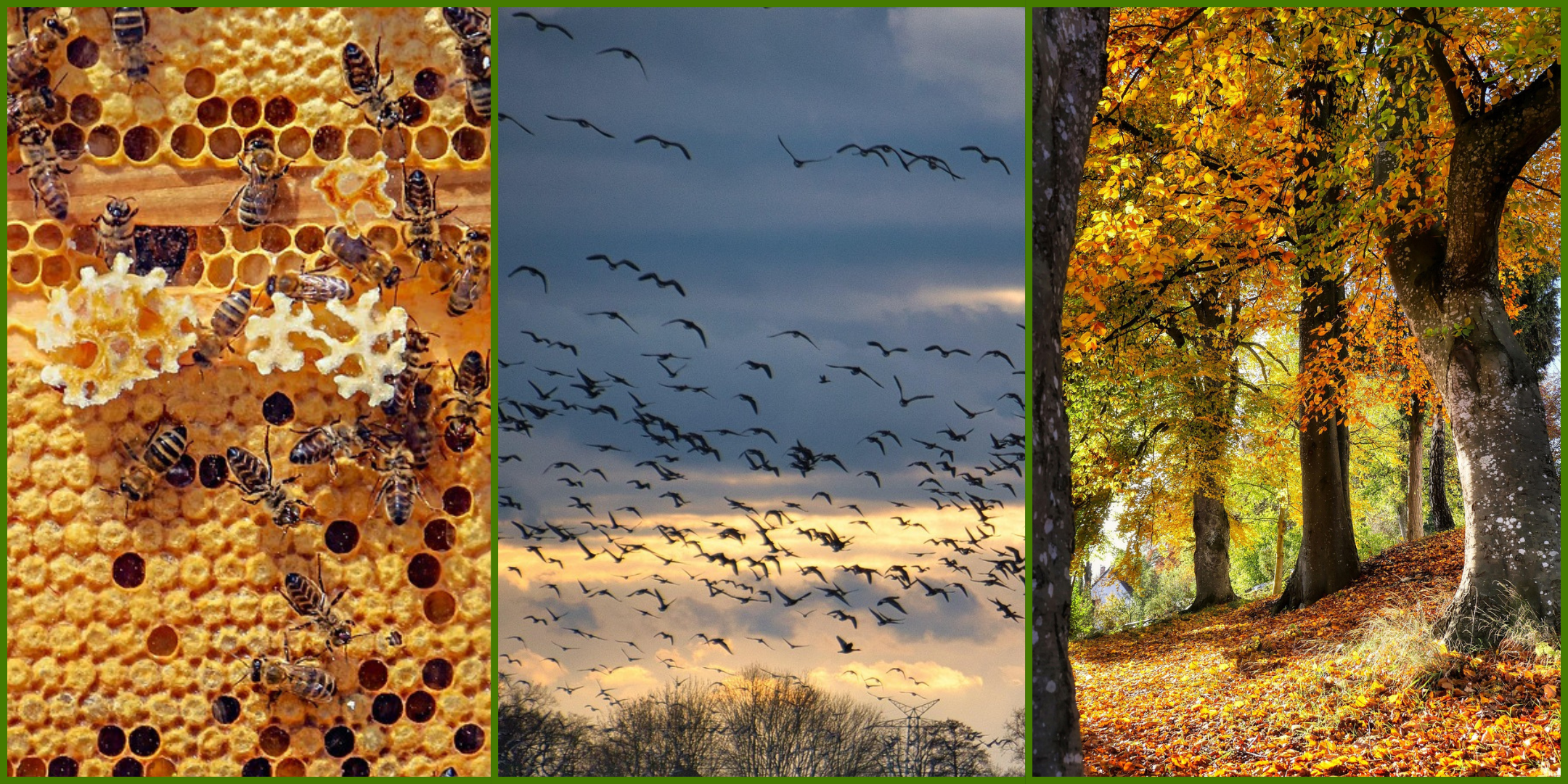
Lesson 1. Structure Like a Beehive
Decentralisation | Shared Purpose | Fast Information Flow
A beehive doesn’t have a CEO, no endless meetings and no 60-page strategy decks. Yet it’s one of the most coordinated operating models on earth — and it’s been perfecting itself for millions of years.
The hive works because of three simple principles:
1. Shared Purpose: Every bee knows the goal: protect and sustain the hive. Purpose is clear, meaningful and actionable — no ambiguity, no mixed messages.
2. Distributed Authority: Worker bees, nurse bees, scout bees — all have autonomy within their role. No bottlenecks. Leadership at every level. Research suggests that companies giving employees a “high level of freedom” are 10 to 20 times more likely to outperform those with lower autonomy scores.
3. Fast, Transparent Information Flows: Bees use waggle dances and pheromones to share information instantly across the colony. In human organisations, information is often the most constrained resource — hoarded, filtered, delayed. The hive has no time for that.
Ask yourself:
- Is our purpose simple enough to guide autonomous action?
- Where are decision bottlenecks slowing us down?
- How can information flow more freely across teams?
Lesson 2. Adapt Like a Flock of Birds
Agility | Simplicity | Real-Time Responsiveness
If you’ve ever watched a murmuration of starlings, you know the magic. Murmurations can include up to 750,000 birds moving as one fluid shape, shifting direction in milliseconds. They fly at speeds of up to 50 miles per hour, and yet they almost never collide.
There is no leader. No command-and-control structure. Just three simple rules — each bird stays close to its neighbours, avoids collisions, and matches speed and direction. Research has confirmed that each starling only tracks the six or seven birds nearest to it. From those simple local interactions, breathtaking complexity emerges.
Organisations often struggle with agility because they create too many rules, disconnected from day-to-day reality. What they actually need are operating principles that are:
- Simple
- Memorable
- Actionable
- Contextual
Imagine replacing 45 KPIs with three guiding behaviours – for example:
- Prioritise customer value
- Share early, learn fast
- Rely on collective intelligence
That’s not a loss of rigour. That’s a gain in adaptability.
Ask yourself:
- What three behaviours would transform our organisation if everyone followed them?
- How can we design just enough structure to guide movement – but not restrict adaptability?
Lesson 3. Regenerate Like a Forest
Interdependence | Diversity | Renewal
Forests aren’t just collections of trees — they’re deeply interconnected communities. Beneath the surface lies what scientists call the “Wood Wide Web”: a vast network of mycorrhizal fungi connecting trees through the soil. A single teaspoon of healthy forest soil can contain up to 100 metres of fungal threads.
Through these networks, trees share water, carbon, nitrogen and nutrients. Older “mother trees” send resources to struggling seedlings. When one tree comes under attack from pests, it releases chemical signals that travel through the fungal network, priming neighbouring trees to ramp up their own defences — before the threat even arrives. Around 90% of all plant species depend on these mycorrhizal relationships to survive.
This is what regeneration actually looks like: not individual heroics, but mutual support across a whole system.
Organisations can take three things from this:
1. Build Interdependence, Not Silos: Forests thrive because resources flow to where they’re needed most. Your teams should too. Knowledge, people and ideas that sit locked in one corner of the business are the organisational equivalent of a tree hoarding nutrients.
2. Nurture Diversity: Monocultures are fragile — in nature and in business. Mixed-species forests are significantly more resilient than single-species plantations. Diverse teams — in thinking, background and experience — are more adaptive, more creative and better equipped to handle uncertainty.
3. Invest in Renewal: Forests regenerate through rest, decomposition and new growth. Burnt-out ecosystems collapse. Burnt-out teams don’t innovate. Building in genuine space for reflection, learning and recovery isn’t a luxury — it’s a structural necessity.
Ask yourself:
- Are we operating as isolated trees, or as a forest?
- Where can we enable more flow — of knowledge, people and resources?
- How do we embed regeneration, not just sustainability?
Real-world organisations already doing this
You don’t have to look far to find nature-inspired design in action:
- UPS used ant-colony algorithms to underpin their ORION routing system – saving 10 million gallons of fuel annually, reducing CO₂ emissions by 100,000 metric tons, and generating $300–$400 million in annual cost savings.
- IBM’s Communities of Practice mirror forest networks, enabling knowledge to flow across the organisation like nutrients through mycorrhizal threads.
- Spotify’s squad model mimics self-organising units found throughout nature – small, autonomous, purposeful.
- Where the Mind Grows has based their entire coaching business around nature itself
The shift is already underway. Organisations are moving:
- From linear to circular
- From efficiency to effectiveness
- From ownership to stewardship
- From competition to collaboration
- From short-term gains to long-term regeneration
A New Way of Designing Organisations
Nature invites us to rethink some of our most basic assumptions:
- From hierarchy → to networks
- From control → to autonomy
- From efficiency → to resilience
- From sustainability → to regeneration
We don’t need to copy nature literally. We need to learn from its patterns – the strategies it has developed over billions of years for flourishing in complexity. Nature doesn’t plan for certainty. It designs for adaptability. And that’s exactly the capability most organisations need right now.
Imagine If every team in your organisation…
- Aligned like a hive
- Adapted like a flock
- Regenerated like a forest
What kind of organisation would that be?
Probably one that doesn’t just survive the future – but innovates and thrives in it.
If you want to find out how Optimo can help you enhance your operating model, get in touch with Danielle at danielle@optimobusiness.co.uk.
