
B Corp

I first came across the B Corp movement early in my business adventure. It was during lockdown when we were all stuck at home, meaning webinars became the go-to mechanism for sharing and learning in business. We had a whole world of events on our screens and at our fingertips.
A few months into lockdown I spent some time reflecting on my personal values. I developed these into an early iteration of the business values that exist in Optimo today. I was already really clear that making a positive difference in the world was going to be a huge part of what I wanted to do with my business.
The first step I decided to take with my new values was to explore how they would play out in terms of the types of clients I wanted to work with.
- I had a strong passion for climate action.
- I was keen to work with organisations that had a sustainability-focused product or service.
- I thought that if I could use my operations, project, and change experience to make them more efficient, they could save the world faster!
The more I learned and developed my knowledge, the more I recognised that sustainability was not just about climate action. It’s about using the UN Sustainable Development Goals as a framework. It was much wider than that – and I found a ‘compass’ for my work.
Background
As my business grew, I started to think about the impact we were having on the world around us – both environmentally and also for the people I employed. Particularly as my first hire was a local university student. I was determined to create a fair and enjoyable working environment for her and other future team members. I also became more conscious of the type of suppliers and partners I engaged with. It made me wonder about other ways we could support our wider community. And I continued to hear about and admire the B Corp label.
But for ages, I was convinced that it wasn’t suitable for a small business like mine. I assumed it was only relevant for bigger organisations that had a bigger team, or business premises and equipment. I was also conscious that as a micro business, time and money are scarce. So even if I’d realised earlier than I did that it would still apply to me, I assumed I’d need a magic wand to find the time to look into it properly!
The process
In 2021 our Improvement Manager, Mollie, joined the business as my second hire and in the same year we joined the Better Business Network.

One of the member benefits of the network is access to the expertise of Founder Hannah. Hannah also runs impact agency betternotstop, which she has translated into an online ‘B Corp Bootcamp’!
With access to this B Impact Assessment knowledge and Mollie’s passion and capable extra pair of hands, we finally started to properly think about pursuing the B Corp certification.
As a small team, it took us a while to get through the assessment and really operationalise some of the various elements. As we made progress in setting up our policies and processes, some grumblings were doing the rounds about some organisations with questionable positive impact achieving their certification.
I must admit, it made me wonder about the robustness of the framework. How could these businesses genuinely be meeting the “highest standards of verified social and environmental performance, public transparency, and legal accountability to balance profit and purpose”?
But we still continued through our assessment. Increasingly I was reassured by the lengths we were going to, to properly embed these good business practices.
The Result!
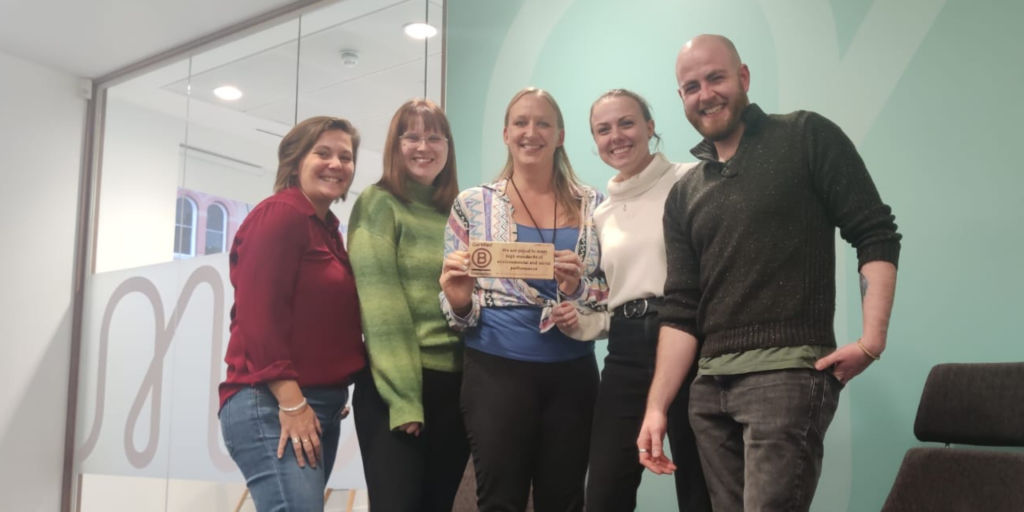
We finally submitted our application in November 2022. In August 2023 we became the first LGBTQ+ and female-founded consultancy in Yorkshire to achieve B Corporation certification. We were even featured in the Yorkshire Post!
And at the time we were one of only 20 female-founded and led consultancies in the whole of the UK with the B-Corp status.
The benefits
B Corp has since been working on updating and improving the standard, which will hopefully address some of the concerns lots of people have had about the validity of the certification. But I also don’t think B Corp should be used as a standalone ‘badge of honour’.
I’m incredibly proud of our certification because I know how much hard work went into achieving it and I liked the framework that it gave us to work through. But I also don’t believe that it’s a silver bullet, or that it always tells the full picture (which is the point of the concerns that have been voiced by many). Hence we should be wary of seeing it as a badge or a marketing tool.
There is, of course, a potential commercial benefit to certifying. Many people look out for the B Corp logo when making purchasing decisions. I know because I’m one of them. But to me personally, this doesn’t feel like the right reason to pursue it on its own.
I do, yet, also believe there is value in the external impact generated through the encouragement and inspiration for others to consider the certification for themselves, where they might need some direction or validation of the way they do things.
From my perspective…
The impact we are seeing at Optimo so far of having achieved our certification is both internal and external.
The way we run our business aligns with the framework. We track progress measures that cover the components of the assessment. We challenge ourselves to improve the way we do things as a matter of habit. This also means the improvement needed for re-certification, if we decide to do it, should be easier. Our team members feel proud to talk about it. We use it to test ourselves on how we’re running the business for the benefit of more than just mine and Vicky’s back pockets!
As mentioned above, we are also seeing other business leaders in our network become interested in the assessment. You could argue that the traditional world of management consultancy might benefit from a pointer or two from the certification! We’re also having conversations with creative agencies, events companies, and manufacturers about our experiences and how they might start their own B Corp journey.
So…
I think the value of B Corp depends on your starting point and why you want to pursue it.
I know many businesses (and their leaders) whose entire existence revolves so fundamentally around regeneration and sustainability, including their service or product and the way they deliver it, that the certification wouldn’t particularly serve them or their stakeholders.
But if you’re even vaguely interested in improving the way you do things, validating any existing good practices you have, and encouraging others to do the same – I would definitely recommend it.
And if you’d like a chat with us to hear more about our experiences, get in touch!
